
Most calendars show a single number. The meetings of the month.
That number goes up, you’re happy. It goes down, you worry. Either way, you don’t know why.
A big number when you don’t know what it measures is decoration. Here are the ten that really decide.
On this page
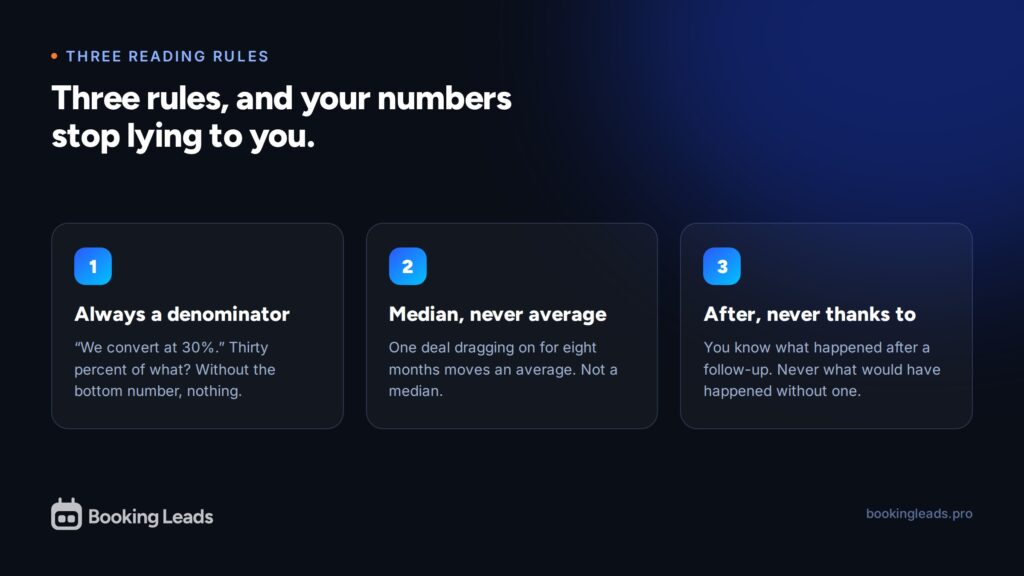
First: a rate needs its denominator
“We convert at 30 %.” Thirty percent of what?
A rate is a division. Without the bottom number, it means nothing. Many dashboards show the top and hide the bottom.
Second rule, just as simple. A count changes in percent. A rate changes in points. Going from 10 % to 13 % is three points, not three percent.
Keep these two rules in mind for everything that follows.
The ten numbers, one by one
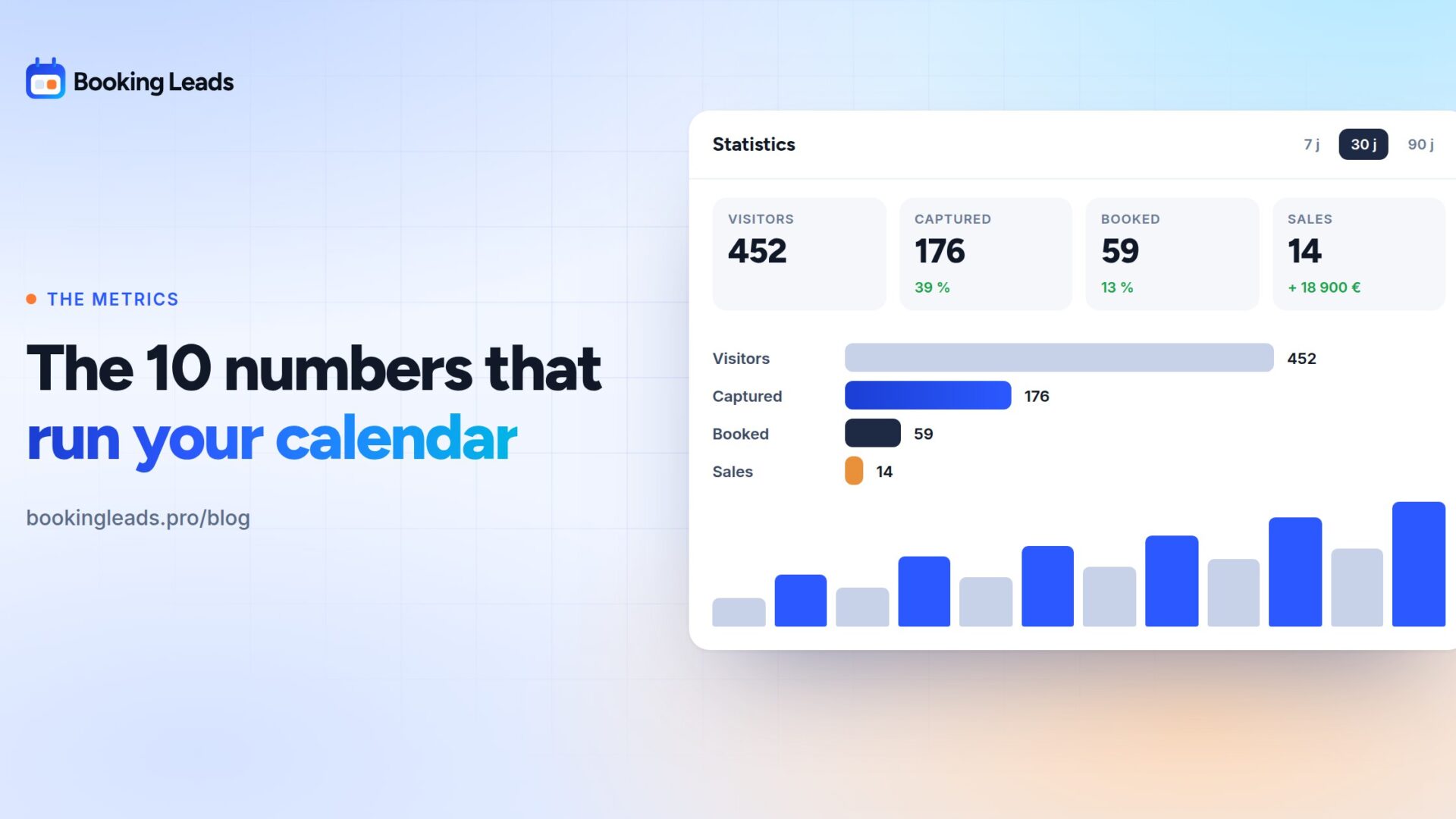
1. Visitors to your booking page
This is the denominator for everything else. Without it, none of the other nine can be read.
Count the visits to the page that holds the calendar. Not the visits to the whole site. You will want to grow it, but only once the next steps are set up right.
2. Captured contacts
How many people left you a name and an email address.
With a standard calendar, this number equals the number of meetings. That’s the heart of the problem: you only know the people who went all the way.
3. Capture rate
Captured contacts divided by visitors. This is your first real indicator.
It measures one thing: the quality of your first request. A form that is too long makes it drop. So does a vague promise.
4. Meetings booked
The only number your calendar already knows.
It’s useful. It just isn’t enough. On its own, it tells you neither where people come from nor how many left before booking.
5. Booking rate
Meetings booked divided by visitors. It’s the number everyone should know, and almost nobody does.
Take a hundred visitors. In many cases, thirteen book. The other eighty-seven are your room to grow, and your advertising bill.
6. Leads screened out by your filters
How many people didn’t get access to the slots, and why.
Keep a close eye on this one. Too low, and your filters aren’t doing their job. Too high, and you’re turning clients away. A screened-out lead is still yours: their contact stays with you, and you can follow up with them in another way.
7. Deals to fill in
Past meetings whose outcome nobody has recorded.
It’s the most revealing number about a team. If it rises, your sales statistics become wrong. A file with no known outcome skews every rate that follows.
8. Win rate
Deals won divided by deals closed. Closed means won or lost.
Keep the files that are still open out of it. They would skew the result both ways. Measure won and lost separately: each one tells its own story.
9. Median time to close
How many days between the meeting and the moment you know the outcome.
Use the median, never the average. A single deal dragging on for eight months is enough to shift an average. The median holds steady.
10. Overdue files
Open deals whose next-action date has passed. Or is missing.
A file with no date isn’t a quiet file. It’s a forgotten one. Count it as overdue, and it stays in plain sight.
Three numbers that lie
These ones look serious. They lead you astray.
- The average: one extreme value moves it. The median holds.
- The percentage with no base: “+40 %” on five files means nothing.
- The “thanks to”: you know what happened after a follow-up. You will never know what would have happened without it.
This last rule is the hardest to keep. It’s also the most honest. Write “after a follow-up”, never “thanks to a follow-up”.
Where to read these ten numbers
Five of them come from an audience analytics tool. The other five only exist once someone captures the contact before the slots.
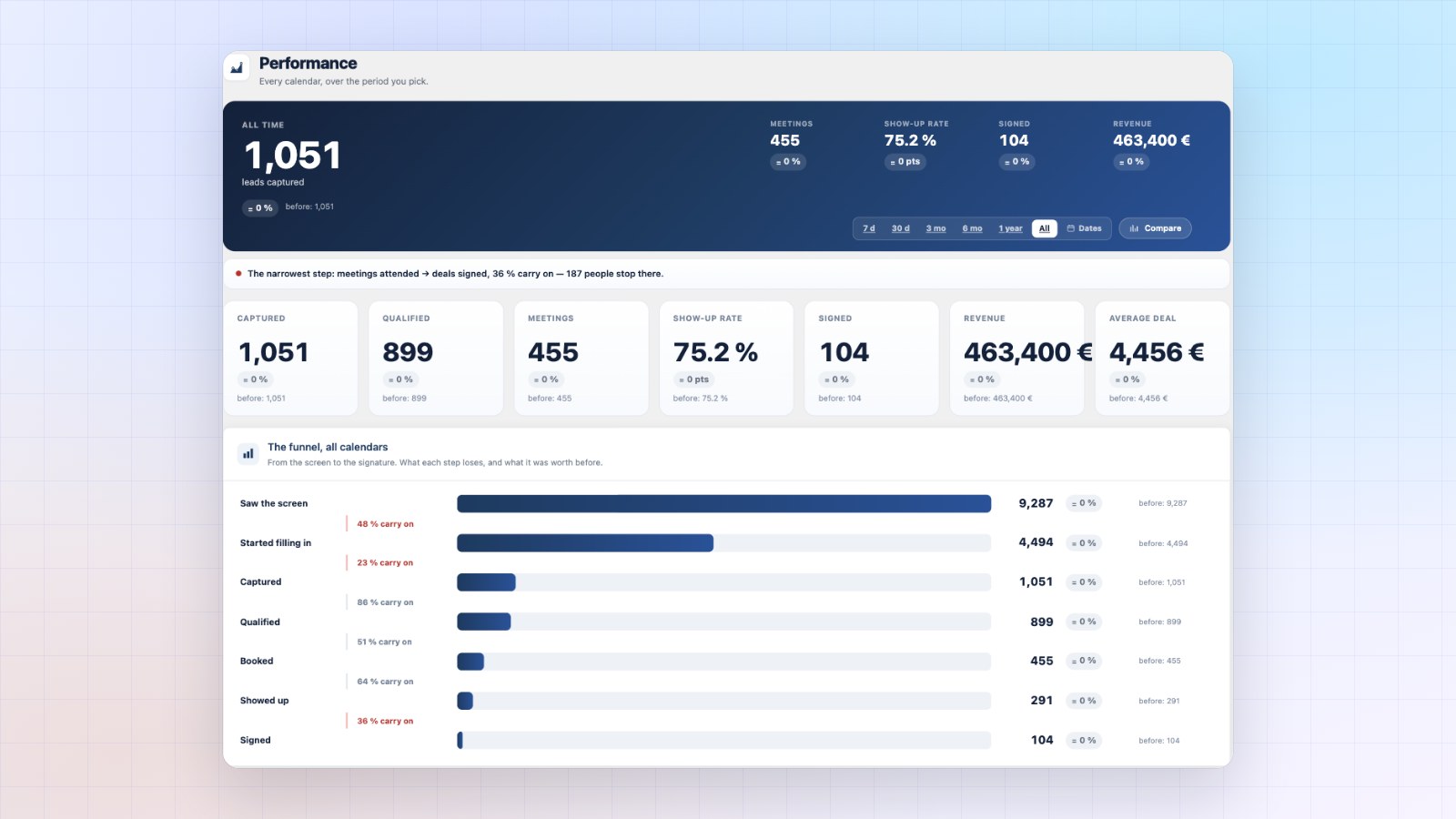
That’s why I built Booking Leads. An access screen sits in front of your calendar and saves the contact before the slots appear. From there, all ten numbers exist.
The funnel screen shows the steps: seen, captured, admitted, booked. You see the step to improve, not just the final result.
The deal tracking screen holds the last four. To fill in, in progress, won, lost. Each file keeps its dated log and its next-action date.
Everything lives in your own site’s database. These are your prospects, not ours: they stay yours alone, out of any vendor’s reach.
Ten numbers for your monthly review
These ten numbers transform your monthly reviews. You stop commenting on traffic. You show the step to improve.
The conversation becomes concrete: here is where visitors leave, here is what I suggest, here is what it gave the following month. A service you can measure is easier to renew.
Multi-site licences cover several clients with a single purchase. White label puts your name in place of ours in their admin.
Ten numbers, together on one screen
Keep the reading rule: a rate always has a denominator, the median beats the average, and a count changes in percent while a rate changes in points.
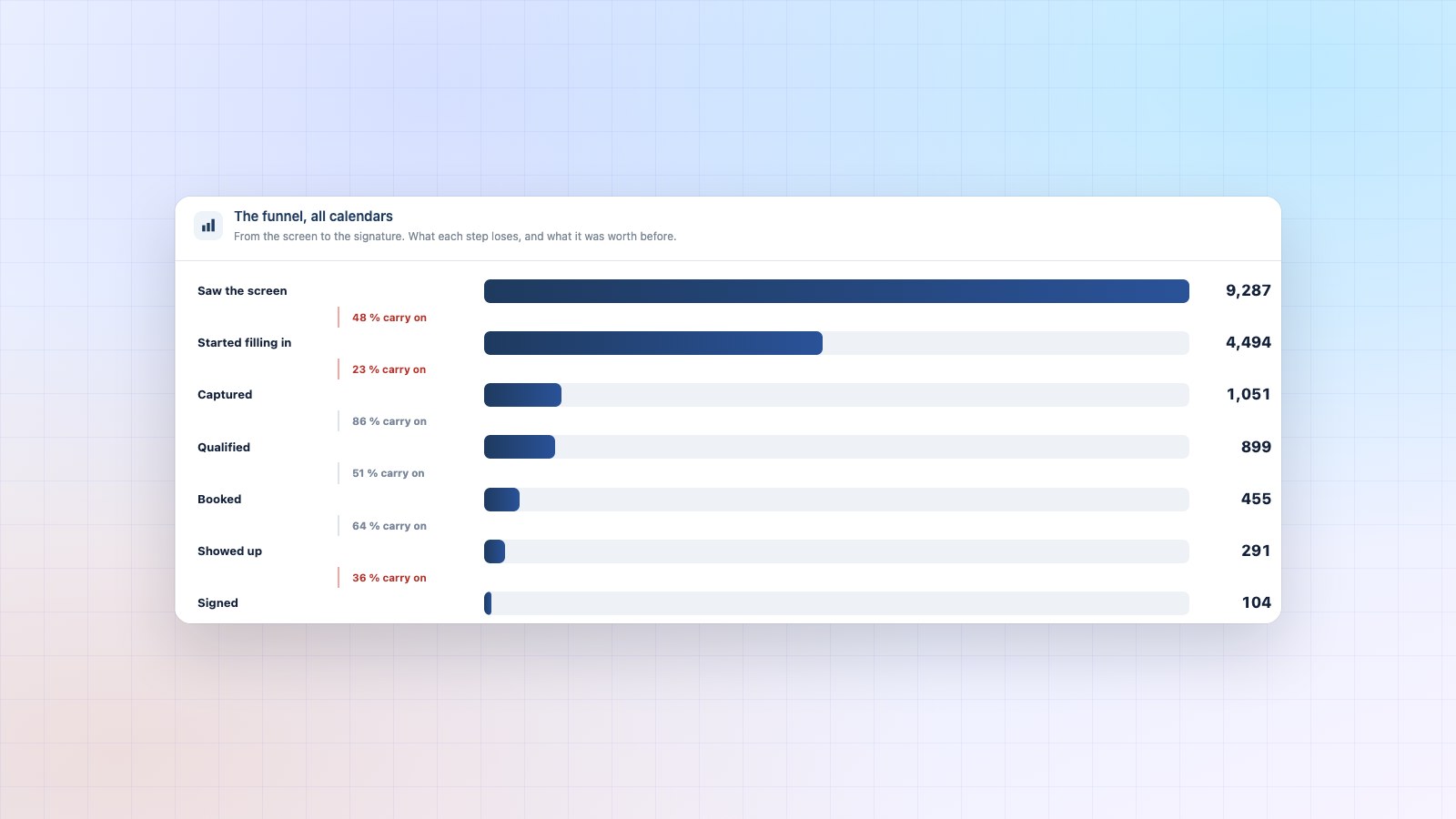
Five of these ten numbers come from an analytics tool. The other five appear the day the contact is captured before the slot grid.
From then on, you steer instead of just observing. The funnel points to the step to improve, deal tracking ties each meeting to its amount, and the monthly summary comes to you by email.
For an agency, these ten lines transform the monthly review. You arrive with the step that moved and what you suggest next. A service you can measure gets renewed.
The demo shows the screens with real data, and the plans are just below.
Your questions about the numbers
What is a good booking rate for a booking page?
It varies with traffic and offer. Many pages sit around thirteen bookings per hundred visitors. Compare yourself with your own previous month rather than with a market average.
Why use the median rather than the average?
Because a single extreme value moves an average. One file open for eight months is enough to double an average delay. The median describes the typical case, which is what you want to steer.
How do I measure visitors who drop off before booking?
Capture the contact before the slots appear. That step turns every drop-off into a usable trace, and the number comes within reach.
Should deals in progress count in the win rate?
Count only closed deals, won or lost. That’s how the win rate is calculated. Including open files skews the result, usually downwards.
What does a growing “to fill in” column mean?
That meetings have taken place and their outcome hasn’t been recorded yet. It’s a matter of discipline, not of tools. Once it’s cleared, your win rates become reliable again.
Can I say a follow-up generated a sale?
Say it came after the follow-up. You know what happened after it. You will never know what would have happened without it. Write “after a follow-up”, never “thanks to”.
How many files does a rate need to be reliable?
There’s no universal threshold. Below a few dozen files, read the counts rather than the percentages: one case more or less changes everything.